A Chinese facility buried far below a mountain was designed for observing the matter that glues the universe together, while also housing other research that can benefit from its unique location.
https://www.nature.com/articles/d42473-026-00104-6
The fact that rapidly spinning galaxies don’t simply fly apart under centrifugal force implies they have far more mass holding them together than we can currently detect. This ‘dark matter’ does not interact with electromagnetic radiation — and therefore doesn’t emit, absorb or reflect light — which has made it impossible to detect.
But now a giant laboratory deep under a mountain in Sichuan, China, may allow researchers to directly observe dark matter for the first time. The location is key. If it were on the Earth’s surface, any detector theoretically sensitive enough to detect dark matter would be overwhelmed by noise from high-energy cosmic rays from space. “The only way to get an extremely ‘quiet’ environment is to use massive mountains or deep water to provide shielding from cosmic rays,” says physicist Hao Ma, who leads the Low Background Techniques Group at the China Jinping Underground Laboratory (CJPL).
Rocky road
CJPL sits under 2.4 kilometres of rock in the middle of a tunnel that was originally built for traffic serving the Jinping hydropower station. “The thick cover reduces the cosmic ray flux to roughly one hundred-millionth of that at sea level, effectively resolving the most challenging interference faced by surface laboratories,” explains Ma.
CJPL is also shielded with systems that use liquid nitrogen, pure water, and solid materials to suppress the effects of gamma rays and neutrons from natural radionuclides in the surrounding rock and concrete. The second phase of CJPL’s development, completed at the end of 2023, brought the total volume of the facility to over 300,000 cubic metres and made it the deepest — and one of the largest — underground laboratories in the world. It now hosts two dark-matter detectors: CDEX, which uses 50 kilograms of high-purity germanium to detect electrical signals triggered by the passage of a dark matter particle, and PandaX, which uses 3.7 tonnes of liquid xenon to detect light signals. Such experiments depend on Sichuan’s steep-sided mountains, which provide the rock overlay but also allow relatively easy access through horizontal tunnels.
CJPL has ties with facilities including the Gran Sasso National Laboratory, in Italy, Modane Underground Laboratory in France, Yemilab in Gangwon Province, South Korea, and Kamioka Observatory in Gifu Prefecture, Japan. “We collaborate and exchange knowledge about underground laboratory construction, operational management, and low-background experimental techniques,” says Ma.
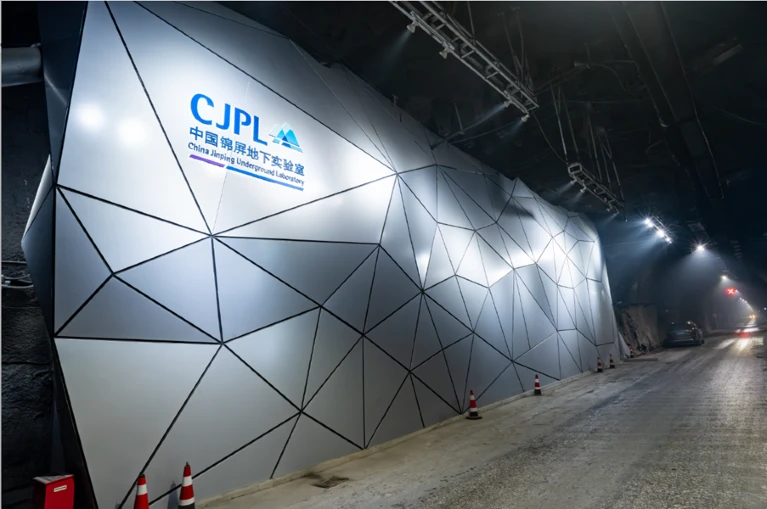
China Jinping Underground Laboratory is one of the world’s largest underground facilities for detecting dark matter.
Deep understanding
CJPL may not yet have detected dark matter, but it is already helping astrophysicists deepen their understanding of the universe. This includes the Jinping Underground Nuclear Astrophysics experiment, which helped explain the origin of the calcium abundance in the oldest known star in the universe. Other work detecting neutrinos from the sun or supernovae could reveal insights into the inner workings of stars.
CJPL’s unique environment is also perfect for experiments outside of astrophysics, such as studying deep underground rock mechanics and investigating neutrinoless double beta decay, a rare nuclear process that could reveal whether neutrinos are their own antiparticles. This type of diversification will be a central part of the future of the laboratory, says Ma.
Detecting the elusive dark matter remains CJPL’s primary aim. But, says Ma, “the laboratory will soon expand into a range of disciplines that benefit from the low levels of cosmic rays, including deep underground biology, medicine, and quantum computing.”


